
Reclaim Your Attention — Leave Gambling Behind for Good
If online casinos or slot machines are taking a toll instead of adding value to your life, now is the moment to shift direction. Clear your mind, restore your sense of control, and step into a more balanced future with confidence.
Every year, thousands of people decide to break free from gambling addiction and start rebuilding their lives. You have the power to do this too. Gambling addiction isn't a matter of weak willpower or bad decisions, but a recognized medical condition that alters how the brain responds to risk, reward, and stress.
You're here for a reason—perhaps you've already decided "enough is enough." Recognizing that gambling is no longer just entertainment isn't weakness, but the first and most important step.

Every year, countless people decide to break free and rebuild — you have the strength to do the same.
Why Slot Machines Are So Addictive
-

Rapid gameplay
-

The near-miss illusion
-

Intense dopamine response
-

False sense of control
"The Crack Cocaine of Gambling"
Slots aren’t just harmless fun. They’re one of the most efficient
systems ever created to hook attention
and keep people playing. Many experts even compare them to “the crack cocaine of gambling” — not as a
metaphor for drama, but because of how precisely they’re engineered to keep the brain engaged and coming
back.
Here’s what makes them especially powerful:
Speed matters
Each spin takes only a few seconds. In a single hour, a player can go through hundreds of rounds. There’s barely any pause to reflect — money and time disappear almost instantly.
Sensory stimulation
Lights, sounds, and celebratory effects accompany even the smallest wins. These signals create strong dopamine bursts, reinforcing the behavior again and again.
The near-miss effect
Reels often stop just short of a win. To the brain, that feels like progress instead of loss — triggering the urge to try again because success seems “close.”
Bonuses and “almost control”
Free spins and rewards give the impression that persistence leads to success — even though outcomes are random.
Why Real-Money Slot Gambling Can Be Risky
Slot machines are often presented as simple entertainment, but behind the flashy image lies a system
designed to keep players spending. Once real money is involved, the experience changes—it's no longer
just a leisure activity, but a continuous cycle in which losses can accumulate quickly and almost
imperceptibly.
Illusion of control. Bonuses and "near wins" create the deceptive feeling that
the player has some influence. In reality, each spin is subject to fixed probabilities that
mathematically inevitability favor the operator.
Rapid habit formation. Due to the high speed
and repetitive nature of spins, behavioral patterns become ingrained much more quickly than in other
forms of gambling. Compared to table games or sports betting, slots can lead to problematic addiction
much more quickly.
The "chasing loss" effect. When a gambler loses money, the brain activates
the same system as when seeking a missed reward—the desire to "win back" arises. This is one of the most
powerful triggers leading to uncontrolled spending.
Real consequences. Over time, the damage
extends far beyond finances: debts mount, relationships deteriorate, and work and mental health suffer.
In severe cases, the stress becomes unbearable and requires professional help.
If gambling
begins to affect your decisions, finances, or daily life, take it seriously. Support exists, and there
is a way out.
Playing slots for real money isn’t as harmless as it may seem. If it starts affecting your decisions, finances, or daily life, it’s worth taking it seriously — and remembering that support and a way forward do exist.

A Safer First Step
If quitting gambling immediately seems overwhelming, try a temporary harm reduction strategy.
Free
social casinos as a temporary buffer. Playing games without real money can temporarily relieve pressure and
help manage cravings. Since there is no financial risk, this provides a brief respite while you work on
long-term changes.
It's important to understand: this solution is not permanent and does not replace
real support. It can help you get through the acute stage, but true recovery requires deeper, structured
work on behavior and beliefs.
Alternative strategies for cravings:
- Urge Surfing - observe the craving without giving in to it. The peak usually passes within 10-15 minutes.
- 5D Technique - Delay, Distract, Deep Breathe, Decide, Discuss.
- Physical activity—a brisk walk or a few squats—will refocus your focus.
- Join a support group (Gamblers Anonymous or similar)—a community where people share experiences and build accountability through regular meetings.
Important:
This approach shouldn’t be seen as a long-term answer or a substitute for real support. While
short-term options can help take the edge off cravings, meaningful recovery usually involves deeper,
structured changes in behavior and mindset.
Support groups like Gamblers Anonymous provide a
well-established, community-based path forward, where people connect, share experiences, and build
accountability through regular meetings.
In moments of strong urges, using a free demo game
without real money may help relieve immediate tension. However, it’s only a temporary coping
strategy—not a real solution. Lasting progress typically comes from ongoing support, developing
healthier habits, and working through the underlying causes over time.
Quick Self-Check (2 Minutes)
Take a moment to honestly reflect on the past year. For each question, choose: Never / Sometimes / Often / Almost always
Questions:
- 1. Have you spent more money on gambling than you could afford to lose?
- 2. Did you need to increase your bets to feel the same excitement?
- 3. Have you returned to gambling to try to win back losses?
- 4. Have you resorted to securing loans, selling possessions, or pawning valuables to finance your wagering?
- 5. Has the thought crossed your mind that your relationship with gambling might be problematic?
- 6. Has gambling introduced persistent tension, unease, or disrupted your ability to rest at night?
- 7. Has your wagering behavior created monetary hardship for either yourself or those closest to you?
- 8. Have you been burdened by remorse or shame concerning the way you gamble?
- 9. Have you attempted to conceal the true extent of your gambling from people you care about?
If three or more of your answers are anything other than "Never," gambling may
already be affecting your life more than it seems. This isn't a diagnosis — just a signal worth paying
attention to.
You're not alone, and support is available. Groups like Gamblers Anonymous offer
free, confidential help. Reaching out could be your next step.
A Supportive Path to Recovery
You can choose different paths to recovery — and that's okay:
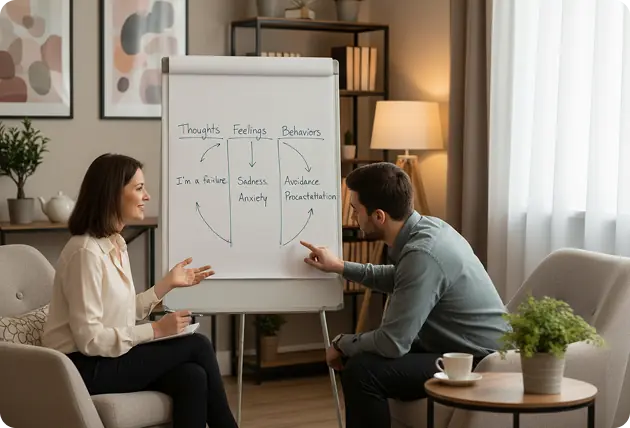
Cognitive behavioral therapy (CBT). The most studied treatment for gambling addiction. It helps identify and change distorted thoughts (e.g., "I'm about to win big"), develop healthy coping strategies, and reduce problematic gambling behavior. CBT can be conducted with a therapist or through self-guided online programs.
Motivational interviewing. A method for coping with ambivalence — when part of you wants to stop, while another part pulls you back to gambling. A therapist helps you independently discover internal reasons for change, rather than imposing them from the outside.
Self-help groups (12 steps). A free, confidential space where people help each other move forward. The program is built on consistency, personal responsibility, and connection with those who truly understand what you're going through.
Medication-assisted support. In some cases, if withdrawal from gambling triggers severe anxiety or depression, a doctor may prescribe short-term therapy to stabilize the condition.

12-Step Recovery Path
The 12-step program isn't a set of rigid rules, but a flexible roadmap that thousands of people have already followed. Below, each step is broken down into specific actions and internal guidelines. You don't have to do everything at once. Just start with the first step.
Frequently Asked Questions
This section provides clear and supportive information to help you understand gambling-related risks and the available paths toward recovery.
-
No, the platform is completely free. You won't find any hidden subscriptions, paid "premium" access, or trial periods that turn into automatic charges. All articles, self-assessment tools, 12-step guides, and support contacts are provided free of charge. Why? Because the platform's goal is to help people regain control of their lives, not to profit from their vulnerabilities. If you ever see an offer to "pay for the full version," that's not from us. We are funded by grants and donations, not by users.
-
No, and this is a matter of principle. You can read, complete self-assessments, explore the steps, and even save your notes locally (in your browser or on your device) without creating an account. We don't require a name, email address, phone number, or any other identifiers. Why is this important? Because the stigma surrounding gambling addiction makes many people afraid to seek help. Anonymity lowers this barrier. The only exception is if you choose to follow an external link to a support group or psychological service website; they may have their own registration rules. But the platform itself does not.
-
No account or registration is needed. All materials and tools are immediately accessible, so you can start using the service right away without going through any sign-up process.
-
The platform offers four main types of resources:
- Educational materials — articles and guides on the mechanisms of gambling addiction (how slots work, why "chasing losses" occurs, what is the near-miss effect). Written in simple language, but backed by research.
- Self-reflection tools — short questionnaires, tables for tracking triggers, an emotion diary, and calculators for time and money spent.
- Step-by-step guides — a detailed 12-step program (above), strategies for coping with cravings (urge surfing, 5D technique), and tips for building financial barriers.
- Referrals to external help — lists of free anonymous groups (Gamblers Anonymous, SMART Recovery), crisis hotline contacts, and recommendations for finding a CBT therapist with experience working with gambling.
The platform is not a substitute for professional treatment, but can be a first step or a complement to it.
-
No, absolutely not. Relapses are part of the recovery process for many people. Research shows that the path to lasting change is rarely linear. If you gamble after a week or a month of abstinence, it's not a "return to zero." It's information: what triggered you? What can you do differently next time?
What to do after a relapse:
- Don't beat yourself up. Guilt only intensifies the craving.
- Write down what happened (where, when, how you felt 10 minutes before the relapse).
- Return to steps 1 or 2 — not because you're "starting over," but because you need support right now.
- Contact a support group or call a hotline.
The main thing is not to turn one relapse into a prolonged binge. Stop after one episode. And remember: dozens of people who currently lead Gamblers Anonymous meetings have also relapsed. That doesn't make you a loser.
-
Yes. Although the mechanics of different forms of gambling differ (speed, role of skill, social aspect), the basic neurobiological mechanisms of addiction are common: dopamine surges from an uncertain reward, control bias, and the pursuit of loss. The platform is primarily focused on slots, as they are recognized as the fastest and most addictive form, but almost all the tools (self-assessment, 12 steps, strategies for coping with cravings, CBT approaches) also work for sports betting, poker, lotteries, and daily fantasy sports.
The only difference is that with poker or betting, which involves analysis, it's sometimes harder to admit an addiction exists because the person believes in their own "strategy." If you're asking yourself this question, chances are gambling has already begun to interfere with your life. And the platform's resources are suitable for you.
-
This is a very difficult situation. You can't force someone to change, but you can change your behavior and create an environment where it's easier for them to seek help.
What can be done:
- Stop financial support. Don't give money for gambling or pay off debts incurred because of it.
- Clearly define boundaries. "I love you, but if you continue to gamble, I can't live in the same house with you / share the budget / turn a blind eye to your lies."
- Offer information. Not a lecture, but simply a link to this website or contact information for a support group — "See when you're ready."
- Take care of yourself. Join a group for codependents (GamAnon, Al-Anon — adapted programs for relatives of addicts).
What you shouldn't do: threaten, manipulate, or cause drama while gambling (this can intensify cravings as a way to escape emotional pain). Remember: you are not responsible for their addiction, but you are responsible for your well-being.
-
No, it's not necessary. Many people successfully recover only through support groups (Gamblers Anonymous) and independent work through the 12-step program. The platform provides these tools freely and anonymously.
However: if you have concomitant depression, panic attacks, post-traumatic stress disorder, or suicidal ideation, a psychologist or psychiatrist is no longer an "additional option" but an essential element of safety. Research shows that a combination of CBT and support groups produces the best results.
How to overcome shame:
- Remind yourself: addiction is a medical condition, like diabetes or hypertension. You're not ashamed to go to the doctor with a heart condition. Many psychologists work online and anonymously.
- You can start with a single, no-strings-attached session and simply express your fear of judgment. A good therapist will see this not as weakness, but as honesty.
- If you're not ready yet, start with self-help and groups. And when you feel like you've hit a wall, remember that a professional can speed up your progress.
What the Research Says: The Science of Recovery
Gambling addiction isn't a lack of willpower. It's a recognized mental disorder in the DSM-5 that alters the brain's reward, impulse control, and stress processing systems.
But research also shows that the brain is capable of neuroplasticity — the creation of new, healthy neural connections to replace old patterns. This means change is real, and you can retrain your brain to respond in new, healthier ways.
Balance is key. Complete abstinence from gambling is the most effective path for most people with problem gambling. However, sometimes a temporary harm reduction strategy can create space for gradual change while you work on deeper, long-term solutions.
You're not alone. Research shows that approximately five million Americans experience problem gambling, but only 8% of them ever seek help. If you're reading this, you're among those who have already taken the first step. Help is available, and there's no shame in accepting it.
Begin Your Path Toward Change
Support is available in different forms—whether in person, online, or over the phone—so you can choose what feels most comfortable for you. You don’t have to face this alone. Move forward at your own pace and reach out when you feel ready. Help is always there when you decide to take that step.
Get Support